
Canada enacts major changes to citizenship law.
Hot Take: You may already be a Canadian citizen by birthright.
If you qualify under the new law, you do not need to apply to become a citizen - you should apply for Proof of your Canadian Citizenship.
Claiming Canadian Citizenship by Descent Under Canada’s New Citizenship Act Bill C-3
The Canadian government has taken the final steps to overhaul its citizenship by descent rules, officially passing Bill C-3, An Act to amend the Citizenship Act (2025). This landmark legislation restores Canadian status to thousands of individuals worldwide who were previously excluded by an unconstitutional restriction known as the “first-generation limit” (FGL).
On November 20,2025, the law received Royal Assent, the final step it needed. While it is not yet officially “in force”, Immigration, Refugees and Citizenship Canada (IRCC) is at work implementing the necessary administrative changes, with an expected timeline of early 2026 for the law to take effect. With this new law, the legal mechanism to grant citizenship retroactively is now established, offering clarity and certainty to families separated from their Canadian heritage by decades of flawed legislation.
Multigenerational Ability
Bill C-3’s retroactive provision now allows for citizenship to flow beyond the first generation, recognizing the entire chain of descent provided there is an original anchor (an ancestor who was a Canadian citizen, either by birth in Canada or by naturalization).
For individuals who were born outside Canada before the bill takes effect, the process is now focused on proving the direct lineal link to the Canadian ancestor. If a direct link can be proved, the applicant, as well as those ancestors in his direct line (e.g. parent, grandparent) is a Canadian citizen, and is recognised as having been a Canadian citizen from birth.
Canadian Citizenship By Descent Scenarios
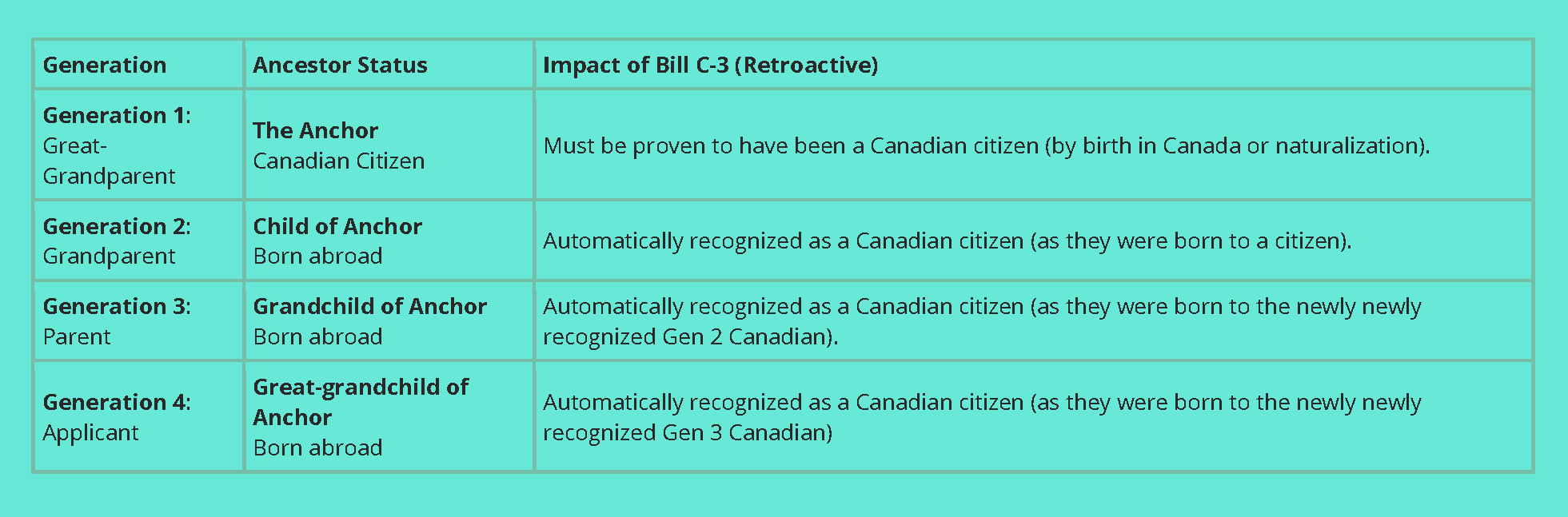
The burden of proof rests with the applicant to demonstrate the direct connection to his/her Canadian-born ancestor. Early commentary from Reddit users suggests that at least at present, the IRCC is being fairly leniant on what documents can be used to prove the link. I would suggest obtaining birth or baptism records where available. Other records that might proove beneficial include census records.
For persons born after December 15, 2025, to a Canadian parent residing outside of Canada, they can be recognised as Canadian citizens also. However, there is a stricter standard that has to be met: their Canadian parent must have had a significant connection with Canada, by having spent at least 1095 days living in Canada.